Is Outsourcing Medical Billing Worth It for a Small Specialty Practice?

Is Outsourcing Medical Billing Worth It for a Small Specialty Practice?
You didn't get into medicine to spend your evenings chasing down unpaid claims or deciphering denial codes. Whether you’re a solo cardiologist or run a three-person psychology practice, you’re an expert in patient care, not Revenue Cycle Management (RCM). Yet the administrative burden of billing is relentless.
Many small practices find themselves trapped. Your front desk staff is stretched thin, and the idea of hiring a full-time, in-house biller feels like a huge financial risk. You know money is slipping through the cracks, but you don't have the time to figure out exactly where or why.
It’s no wonder that by 2025, an estimated 60% of small medical practices will outsource their billing. But is it the right move for you? And with so many options, how can you make a choice that actually boosts your revenue instead of just becoming another line-item expense? Let's break it down with real numbers.
First, what does “good” billing performance look like?
Before you can decide if outsourcing is worth it, you need a baseline. Many practice owners feel like their billing is a problem, but they lack the specific data to prove it. If you don't know your numbers, you can't hold an in-house team or an outside partner accountable.
Here are the key industry benchmarks you should measure your practice against:
Clean Claim Rate (CCR): This is the percentage of claims accepted by the payer on the first submission, without any errors. A healthy CCR should be 95% or higher. Anything less means your team is spending time on preventable rework.
Denial Rate: This is the percentage of claims denied by payers. While you can't avoid denials completely, top-performing practices keep this number low. According to benchmarks from the Healthcare Financial Management Association (HFMA), a denial rate under 5% is an achievable goal.
Days in Accounts Receivable (A/R): This metric tracks how long it takes you, on average, to get paid. A high number of days in A/R can signal serious cash flow problems. Pay close attention to your aging A/R. Industry standards suggest that the portion of your accounts receivable over 90 days old should be less than 10-15% of your total receivables.
If your practice isn't hitting these numbers, every percentage point you miss is revenue left on the table.
How much do RCM services actually cost?
Cost is the biggest hurdle for a small practice. You need to know if you'll see a return on your investment. Pricing models vary, but they generally fall into two main categories.
1. The Percentage-Based Model
This is the most common approach for full-service RCM companies. They charge you a percentage of the money they collect on your behalf. Industry benchmarks show this typically lands somewhere between 3% and 9% of your monthly collections.
The rate often depends on your specialty and claim complexity. For example, a primary care practice might pay 4% to 6%, while a specialty like cardiology could range from 5% to 8% due to more complex coding and prior authorization requirements. The benefit here is that your vendor is only paid when you are.
2. The Software-as-a-Service (SaaS) Model
This model gives you RCM software for a flat monthly fee, usually per provider. Your own staff uses the tool to manage the billing process. This can be more affordable upfront, with prices for some platforms starting at $140 per provider per month. However, it doesn't solve the core problem if you don't have a dedicated, expert staff member to run the software effectively.
When comparing costs, remember to look beyond the sticker price. Ask about hidden fees like setup or implementation charges, long-term contract requirements, and what happens if you want to leave. A reputable partner should be transparent.
Aren't all outsourcing companies the same?
Not anymore. For decades, "outsourcing" meant hiring a company that used a team of people to manually process your claims. But this model is being replaced by a smarter, technology-first approach.
The biggest difference today is Artificial Intelligence (AI).
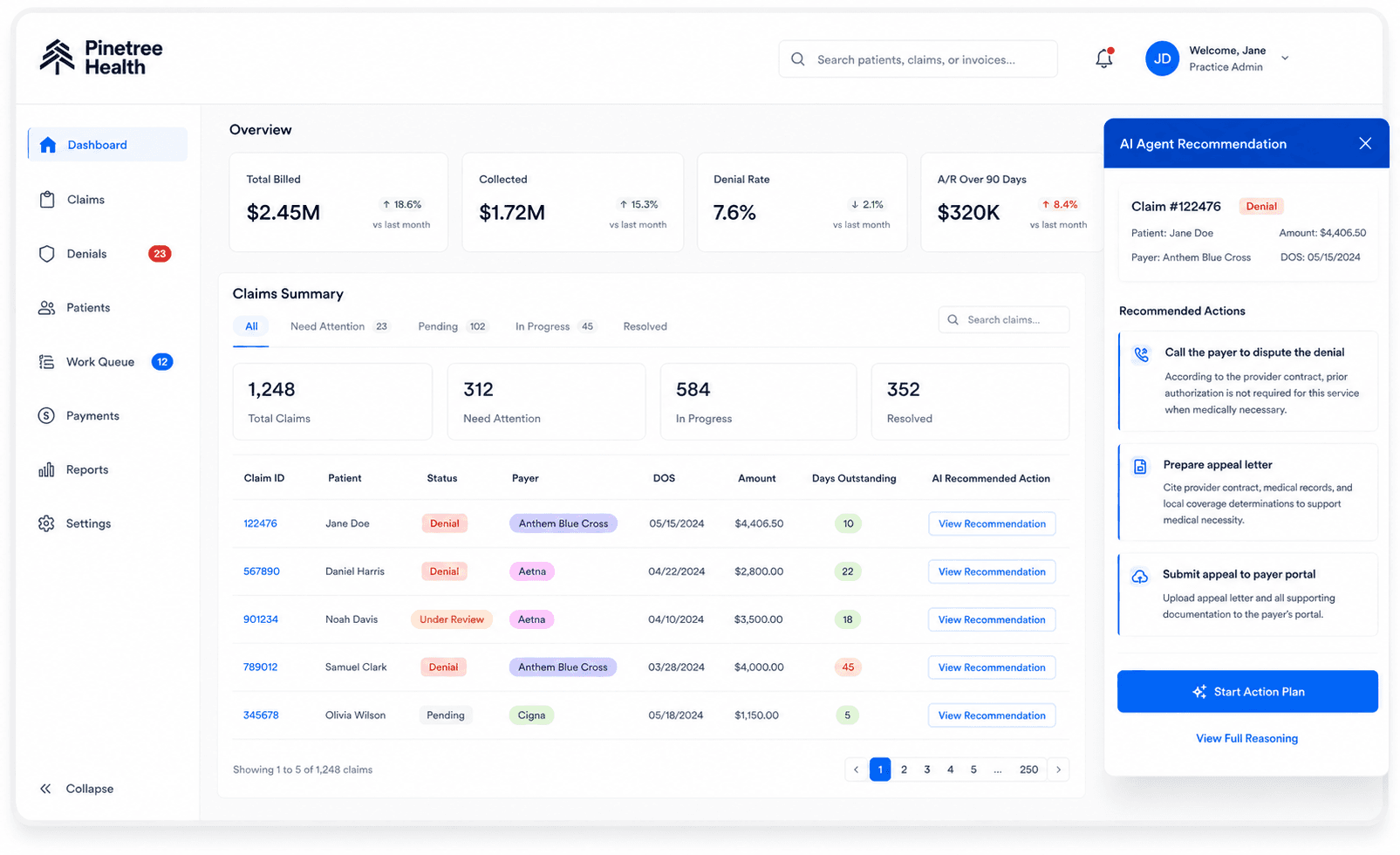
Many older billing services are prone to the same human errors that plague in-house teams. They just do it at a larger scale. Modern AI-powered RCM is different. Instead of relying only on people, it uses automation to handle the most repetitive and error-prone tasks in the revenue cycle. For instance, some AI-driven platforms can achieve a 30-40% reduction in operational costs compared to manual systems.
An AI-powered system can:
Scrub claims for errors before submission: It automatically checks for incorrect codes, missing patient information, or formatting issues that would trigger an instant denial.
Automate eligibility checks: It can verify patient insurance coverage in real time, preventing rejections down the line.
Flag underpayments: The system can compare what you were paid against your contract's "allowed amount" to ensure you're not getting short-changed by payers.
For a small practice, this isn't just a minor upgrade. It’s the difference between a partner who reports on problems and one who prevents them from happening in the first place.
What questions should I ask a potential billing partner?
Vetting a potential partner can feel overwhelming. To cut through the sales pitches, focus on these five critical questions.
What are your specific performance metrics for a practice of my size and specialty? Don't accept vague promises. Ask for their average clean claim rate, first-pass resolution rate, and denial rate.
How does your technology integrate with my current EMR? This is a deal-breaker. A smooth integration is essential to avoid creating more manual work for your staff.
Can you show me a sample of the reports I will receive? You need clear, easy-to-understand reports that give you a real-time view of your practice's financial health. If they only provide a confusing data dump once a month, walk away.
What is your full fee structure, including any setup or termination costs? A trustworthy partner will have a clear pricing model with no surprises. Be sure to ask about contract length and what the process looks like if you decide to part ways.
How do you ensure HIPAA and security compliance? Any company handling your patient data must be able to prove its compliance. Ask for documentation of their security standards, like SOC 2 Type II certification.
So, what’s the right next step?
Making the switch from in-house to outsourced RCM is a big decision, but it doesn’t have to be a blind leap of faith. Start by using the benchmarks in this article to conduct a simple health check on your current billing process. If you find your practice is falling short, it might be time for a change.
The right partner should feel like an extension of your team, not just another vendor. At Pinetree Health, we use AI to help small, independent practices get paid more, faster, and with far less administrative work. By automating the complexities of billing, we empower providers to focus on what truly matters: their patients.