The Only 4 Financial Metrics a Small Practice Owner Needs to Watch

The Only 4 Financial Metrics a Small Practice Owner Needs to Watch
You didn’t go to medical school to become an expert in medical billing. Yet here you are, trying to figure out why cash flow is tight when your appointment schedule is full. You know money is slipping through the cracks, but the idea of digging through dozens of financial reports feels overwhelming. The good news is, you don’t have to.
For a small specialty practice, you don’t need a complicated dashboard with 21 different Key Performance Indicators (KPIs). You just need to focus on four critical numbers. Think of these as your practice’s vital signs. Tracking them weekly will tell you exactly where you’re losing money and what to fix, without wasting hours you don’t have.
1. What is your Clean Claim Rate?
This is the single most important number for a small practice. It measures the percentage of claims that get accepted by an insurance company on the first try, without any errors.
Why it matters: A low clean claim rate is like a leak at the very start of your plumbing. It means you’re creating extra work for yourself before the money even has a chance to come in. The problems are almost always at the front end: typos in patient information, incorrect insurance IDs, or mistakes with eligibility. In fact, simple eligibility issues account for 20% to 30% of all claim rejections. Fixing these errors costs you valuable time and delays your payments.
What’s a good number? Your goal should be a clean claim rate of 95% or higher.
What if your number is low? The root cause is almost always inaccurate front-desk data. One of the most common failures is checking a patient’s insurance eligibility when they schedule, but not re-checking it on the actual date of service. Policies can change overnight. Make it a rule to verify eligibility every single time. Daily charge reconciliation, where you ensure every service delivered is captured in a claim, is also one of the most effective ways to stop revenue leakage.
2. What is your Denial Rate?
While the clean claim rate measures front-end accuracy, the denial rate tells you what payers think of your claims after they’ve been submitted. This is the percentage of claims that are formally denied by an insurance company, requiring an appeal or a complete rework.
Why it matters: Denials are expensive. They don’t just delay your cash flow; they actively drain it. Some studies show that up to 25% of claims are initially denied, and the heartbreaking part is that half of those are never reworked. That’s pure profit left on the table simply because small practices lack the time and staff to fight for it.
What’s a good number? A denial rate above 5% is a serious warning sign that something in your process is broken.
What if your number is high? Don’t just rework denials one by one. Look for patterns. Is it one specific insurance company? One CPT code? A recurring issue with prior authorizations? If you can identify the root cause, you can prevent dozens of future denials. For specialists, authorization errors are a common culprit. If the CPT code on the authorization doesn't match the one on the claim, you'll get a denial that’s often impossible to recover. The key is to submit clean claims quickly, ideally within 24 to 48 hours of charge entry.
3. What are your Days in Accounts Receivable (A/R)?
This metric measures the average number of days it takes for your practice to collect payment after providing a service. It is the vital sign for your cash flow velocity.
Why it matters: High Days in A/R means your money is stuck in limbo. Insurance companies generally have 30 to 45 day processing times for claims, but that clock only starts after they receive a clean claim. Every error, denial, or delay pushes that timeline out further. As a claim ages, the probability of collecting on it drops sharply. Any claim that sits over 90 days is significantly less likely to ever be paid.
What’s a good number? Most industry benchmarks suggest keeping your Days in A/R below 40 days.
What if your number is high? This is a lagging indicator. A high Days in A/R is often a symptom of a low clean claim rate or a high denial rate. The first step is to fix the issues mentioned above. The second step is to have a consistent process for following up on claims. Look at your A/R aging report. Are a few big payers responsible for most of the balance sitting in the 61 to 90 day bucket? Focus your follow up calls there first.
4. What is your Net Collection Rate?
This is the ultimate bottom line metric. It measures the percentage of the total money you are contractually owed that you actually collect from both insurance payers and patients.
Why it matters: This number tells you how much of your earned revenue is truly making it to your bank account. It reveals the impact of everything from unworked denials and payer underpayments to failed patient collections. Many practices focus on the volume of charges but fail to see how much is lost to write-offs and adjustments. According to the Medical Group Management Association (MGMA), the average practice loses 5; 15% of annual revenue due to these exact types of inefficiencies.
What’s a good number? While it varies by specialty, you want this number to be as close to 100% as possible. A rate below 95% indicates significant revenue leakage.
What if your number is low? A low net collection rate points to back-end problems. You might not be catching payer underpayments where they pay less than your contracted rate. Or, more likely, you are not effectively collecting patient responsibility. As high-deductible health plans become more common, the financial burden is shifting. Reconciling bank deposits against posted payments every single day is crucial for spotting these discrepancies before they get out of hand.
What to do next
You don’t need to be a financial wizard to take control of your practice’s revenue. Instead of getting lost in a sea of data, focus on these four vital signs. Check them weekly. If a number looks off, use the simple diagnostics above to find the cause.
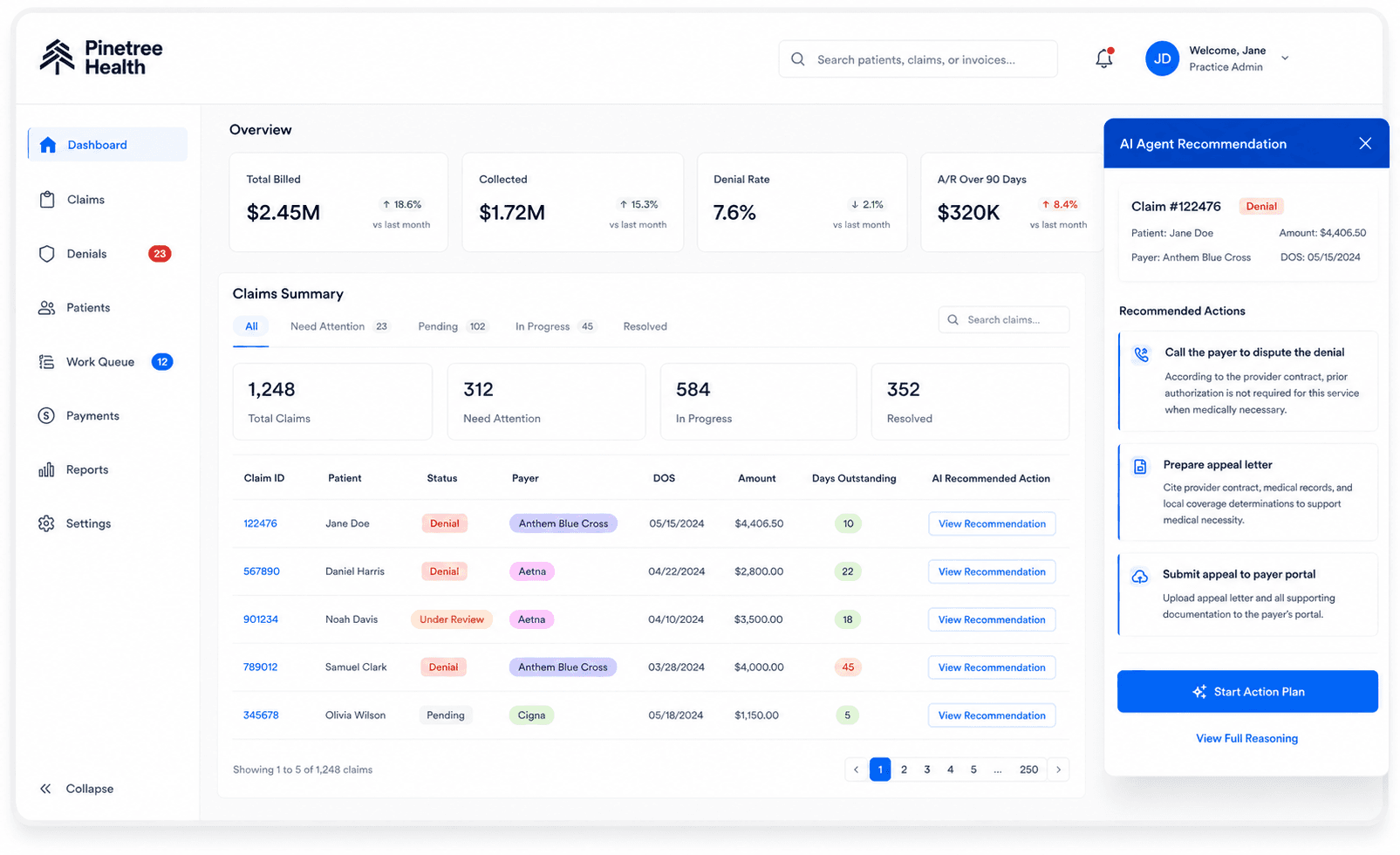
Running a practice is hard enough without having to moonlight as a billing analyst. This is why many small practices are turning to modern tools. AI-powered platforms like Pinetree Health can automate this entire process, flagging risky claims before they’re submitted and automatically identifying the root cause of denials. It gives you the insight of a full-time analyst without the overhead, so you can focus on what you trained for: taking care of your patients.