A Realistic Guide to Reducing Administrative Burden in Your Small Practice

A Realistic Guide to Reducing Administrative Burden in Your Small Practice
If you run a small specialty practice, you have probably read a dozen articles on "reducing administrative burden." And you have probably closed each one feeling more frustrated than when you started.
The advice is always the same: "Implement a unified platform," "centralize communication," or "overhaul your legacy systems." For a three-person cardiology practice or a solo psychologist, this advice is not just unhelpful, it is out of touch. You do not have an IT department, a six-figure software budget, or the time for a months-long data migration that could cripple your practice.
Meanwhile, the problem is very real. On average, physicians spend between one and two hours on administrative tasks for every hour of direct patient care. You feel it every day. It is the mountain of paperwork, the endless phone tag with payers, and the nagging feeling that you are spending more time managing the practice than caring for patients.
So, let's have a real conversation about what a small practice can actually do to reclaim that time.
Why Does Most "Efficiency" Advice Fail Small Practices?
The core issue is that most advice is written for hospital systems, not for you. It ignores the realities of running a small, independent practice.
Prohibitive Costs: "All-in-one" platforms come with enterprise-level price tags. For a small practice, the return on investment is not always clear, and the upfront cost can be a non-starter.
The Nightmare of Switching: Migrating your Electronic Health Record (EHR) or Practice Management software is a massive undertaking. The risk of lost data, the staff retraining, and the inevitable productivity dip are huge barriers for a small team that cannot afford any downtime.
Lack of Integration: Your systems are likely fragmented. The EHR does not talk to your billing software, and scheduling is a separate manual process. The standard advice to "integrate" them often requires custom development or expensive middleware that is simply not feasible.
You are not failing because you are not implementing this advice. The advice is failing because it was not designed for you.
Where Is Your Time Actually Going?
Before you can fix the problem, you need to pinpoint the specific bottlenecks that drain your day. For most small specialty practices, the culprits are not abstract concepts like "workflow inefficiency." They are concrete, daily tasks.
1. Documentation and Charting
This is the most obvious time sink. Clinicians often spend their evenings and weekends just catching up on notes. The industry has started to respond to this. For example, some AI-powered ambient documentation tools... can save clinicians one to two hours per day. While this is a promising area, it is just one piece of the administrative puzzle.
2. Prior Authorizations
For specialty practices, this is a uniquely painful bottleneck. The back and forth with payers, the specific documentation requirements for each plan, and the time spent on hold can consume hours of your admin's day for a single patient procedure. This is pure administrative friction with a direct impact on patient care and revenue.
3. Billing, Denials, and A/R Follow-Up
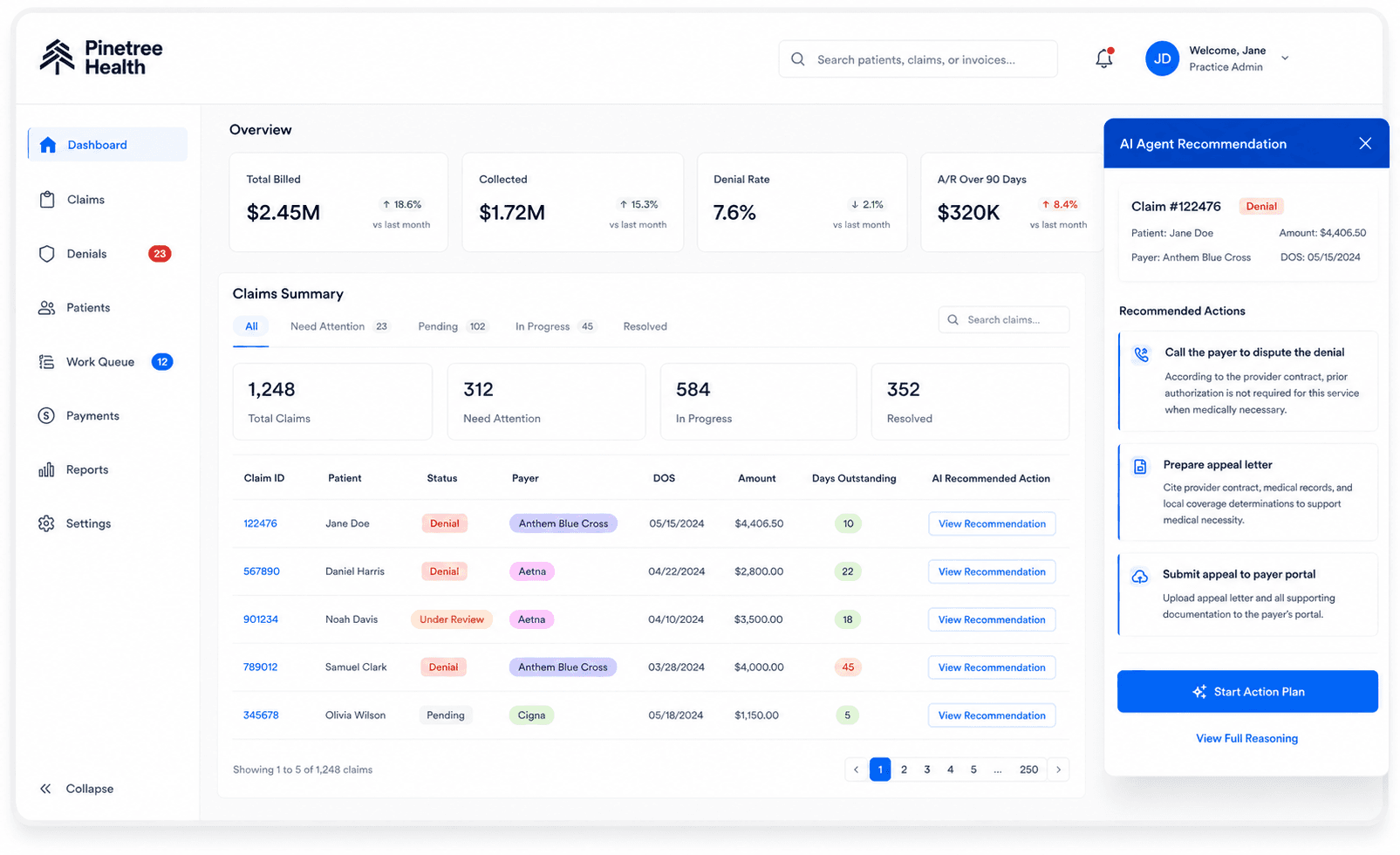
This is the area most generic articles completely miss, yet it is the lifeblood of your practice. Unlike a large organization with a dedicated billing department, you or your office manager are personally chasing down every single denied or underpaid claim. A single complex denial can throw off your entire cash flow for the month. The time spent deciphering cryptic denial codes, resubmitting claims, and following up on accounts receivable (A/R) is immense.
What Can You Actually Do Without a Big Budget?
Forget the idea of ripping and replacing your entire tech stack. The path to reducing administrative burden in a small practice is about making smart, targeted improvements, not massive overhauls.
First, conduct a simple "bottleneck audit."
For one week, have your staff jot down their most frustrating and time consuming administrative tasks. Do not focus on the software, focus on the activity. Is it manual appointment reminders? Is it tracking down patient eligibility? Is it reworking a claim that Blue Cross denied for the third time? This simple exercise will give you a clear, prioritized list of your practice's specific pain points.
Second, look for tools that augment, not replace.
Instead of searching for a new EHR, search for a solution to your number one bottleneck. If prior authorizations are your biggest headache, investigate tech-enabled services that specialize in just that. If claim denials are eating up your time, look for a partner that can integrate with your existing practice management system to handle the revenue cycle. This approach avoids the massive cost and disruption of a full system change.
Third, think in terms of real ROI.
When evaluating any new service or tool, the question is simple: will this save us more time or recover more money than it costs? If a tool costs a few hundred dollars a month but saves your office manager ten hours of work on A/R follow-up, that is time she can now use for higher-value patient-facing tasks. If it helps you recover just one or two complex claims that you would have written off, it has already paid for itself.
The Real Cost of Administrative Complexity
The time you and your staff spend on these tasks is not just a frustration, it is a significant financial drain. In fact, administrative complexity consumes nearly a third of total healthcare spending. For a small practice, that percentage can feel even higher.
The solution is not to buy more complicated software. It is to strategically offload the most complex, time consuming, and specialized administrative work.
By focusing on your biggest pain points first, you can make meaningful progress without the risk and expense of a massive technology project. You can free up your team to focus on what truly matters: providing excellent care to your patients. For many small practices, the biggest and most costly bottleneck is the revenue cycle. Finding a partner that understands the nuances of specialty billing, like Pinetree Health, can free up administrative time while also improving cash flow.
Calculate your revenue leakage for free in 30 seconds today.