Where Is My Money Going? A 3-Step Guide to Finding Hidden Revenue Leaks

Where Is My Money Going? A 3-Step Guide to Finding Hidden Revenue Leaks
Your schedule is full. Your team is working hard. You’re submitting claims on time. So why does your cash flow feel so tight at the end of the month? If this sounds familiar, you’re likely dealing with revenue leakage: small, often invisible drips in your billing process that add up to a significant financial drain over time.
For a small specialty practice, these leaks aren’t just an annoyance; they can threaten your independence. The good news is you don’t need a massive accounting team to find them. By asking a few targeted questions, you can start plugging the biggest holes in your revenue cycle. Here is a simple, 3-step checkup to find where your money is going.
Step 1: Are you being paid what you’re owed?
The most dangerous assumption in medical billing is that a paid claim is a correctly paid claim. You have contracts with payers that set specific rates for your services, but that doesn’t guarantee they’ll pay them accurately. In fact, insurance companies underpay their own contracted rates in 5 to 10% of claims.
This is a quiet, frustrating leak. Payers often use automated claim processing systems that can incorrectly reduce a payment without a clear explanation. For a busy practice, the time it takes to cross-reference every single payment with your fee schedule is overwhelming, so thousands of dollars in underpayments slip by unnoticed.
How to spot this leak:
Run a quick spot check. Pull the last 10 Explanation of Benefits (EOBs) you received for your most common procedure. Find the “allowed amount” for each one. Now, compare that number to your contracted rate for that specific payer and CPT code. Do they match? If you find even one discrepancy, you have an underpayment problem. Doing this manually for every claim is impossible for a small team, which is why this is one of the most effective places to apply modern, automated RCM tools that can perform this check on 100% of your claims.
Step 2: Are you coding too cautiously?
No one wants to trigger an audit. This fear often leads well-intentioned physicians and billers to "play it safe" by undercoding. You know the patient visit was complex and deserved a higher-level Evaluation and Management (E/M) code, but to avoid scrutiny, you default to a lower one. Many practices, for instance, reflexively use 99213 to avoid audit triggers associated with a 99214.
This isn’t safe; it’s a guaranteed revenue loss. The reimbursement difference between a 99214 and a 99213 is $40 to $60 per visit. If you do that just three times a day, you could be leaving over $35,000 on the table every year.
The leak also comes from missed codes and modifiers. For example, missing the 25 modifier when you perform an E/M service with another procedure can cause the services to be bundled, erasing your payment for the visit. Similarly, complex new codes like G2211 for visit complexity are often overlooked, leaving more revenue behind. While you want to be compliant, remember that both CMS and the MACs monitor for downcoding trends, too. The goal isn’t to code low, it’s to code accurately based on your documentation.
How to spot this leak:
Look at your billing data for the last three months. What percentage of your E/M visits are coded at level 3 versus level 4 or 5? If your distribution is heavily skewed toward lower-level codes despite seeing complex patients in your specialty, you may be undercoding out of habit. Also, check for procedures you frequently perform with an E/M service. Are you consistently using modifier 25 when appropriate? A quick review of your coding patterns can reveal a lot about your potential lost revenue.
Step 3: Are your denials piling up?
Every denied claim represents a delay in your cash flow and an increase in your administrative burden. Reworking a single denial is a huge time sink; most practices spend 15 to 30 minutes on each one. When your front desk staff is busy with patients and you’re busy with clinical care, denied claims can easily end up in a pile to be dealt with "later."
But later often means never. Most insurance companies require corrected claims to be filed within 90 to 120 days. After that, the revenue is gone for good. A healthy practice should have a high "first-pass" rate, meaning claims are accepted on the first try. A good benchmark to aim for is that at least ninety-five percent of your claims should be accepted on the first submission. If your rate is lower, it’s a sign that errors in patient data entry, eligibility verification, or coding are causing a major leak.
How to spot this leak:
Calculate your Claim Denial Rate: just divide the number of claims denied in a month by the total number of claims you submitted. If that number is over 5-10%, you have a clear problem. Next, pull your Accounts Receivable (A/R) aging report. How much money is sitting in the 90+ days bucket? This is your highest-risk revenue. If that bucket is growing, your denial management process is leaking.
What should I do next?
Finding these leaks is the first step. The second is realizing that you and your small team can't possibly catch everything manually. You can’t afford to spend 30 minutes on every denial or double-check every EOB against your fee schedules. It’s simply not scalable.
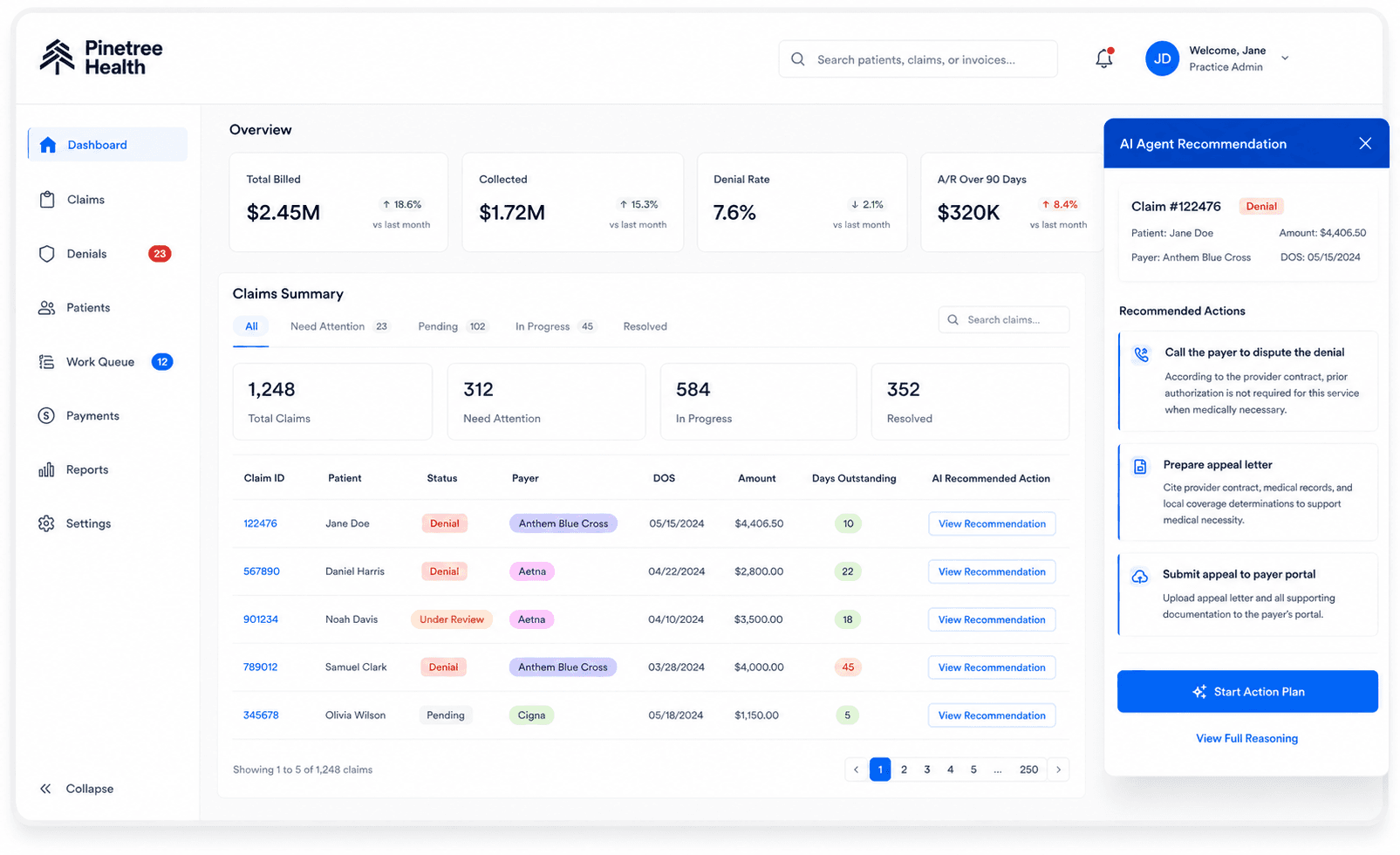
This is where technology becomes your partner. Instead of hiring more staff, you can use intelligent systems to automate these checks. By continuously monitoring for underpayments, flagging potential coding gaps, and tracking every denial from the moment it happens, you can stop revenue leaks before they start.
Modern RCM platforms like Pinetree Health are built specifically for this, giving small practices the analytical power of a large hospital system. This frees you from the administrative burden of chasing down lost dollars so you can focus on what actually matters: caring for your patients.