Why Are So Many Claims Denied? A 3-Step Fix for Small Practices

Why Are So Many Claims Denied? A 3-Step Fix for Small Practices
You didn't go to medical school to fight with insurance companies. Yet, as a physician running a small practice, it can feel like you spend more time chasing down payments than focusing on patients. You submit a claim you know is valid, only to see it come back denied for a reason that feels trivial or opaque. If it feels like the volume of denied claims is growing, you're not wrong. And for a small specialty practice, that lost revenue isn't just a rounding error, it's a threat to your bottom line.
The good news is that most claim denials are not caused by complex clinical disagreements. They stem from small, preventable errors that happen long before the claim is even submitted. By focusing on a few key moments in your workflow, you can dramatically reduce your denial rate, recover more revenue, and win back time for patient care.
Why does it feel like denials are getting worse?
It's not just a feeling. The landscape of medical billing is actively getting more complex. Payers are using their own technology to scrutinize claims more aggressively than ever before. In fact, 61% of physicians say that AI-driven prior authorizations from payers have actually increased their denial rates.
At the same time, the rules are changing. Payers are shortening their filing deadlines and removing grace periods. The upcoming transition to the World Health Organization's ICD-11 (International Classification of Diseases, 11th Edition) will introduce over 17,000 unique diagnostic categories and more than 130,000 clinical terms.
For a small practice without a dedicated billing department, keeping up feels nearly impossible. You're being asked to do more detailed work with less time and fewer resources, all while payers use sophisticated systems to find any reason to say no.
Where do most denials actually come from?
When a claim gets denied, it’s easy to assume the payer is disputing your clinical judgment. But the data shows a much simpler, and more frustrating, reality. The vast majority of denials are administrative. They're about typos, missing information, and process failures.
Consider where the problems start:
Inaccurate Data: A staggering 50% of denials are caused by missing or inaccurate data.
Intake Errors: 26% of denials are attributed to incomplete patient registration or intake data.
Prior Authorization Failures: Missing prior authorizations account for another 21% of denials and influence nearly half of all denials overall.
Add it all up, and you see that most denials are born from simple, preventable mistakes. This is both the bad news and the good news. It means your current process is likely letting revenue slip through the cracks, but it also means you have the power to fix it without hiring a massive team. The goal is to submit a "clean claim," which is a claim that gets accepted and paid on the first try, with no corrections or requests for more information needed.
What's the most effective way to fight back (with a tiny team)?
You can't do everything at once. For a small practice, the key is to focus your limited time on the highest-impact actions. Instead of overhauling your entire office, start with this prioritized, three-step workflow.
Step 1: Master the First Five Minutes (Patient Check-In)
Your front desk is your first line of defense against denials. Since incomplete registration and bad data cause the majority of issues, strengthening your intake process is the single most important change you can make.
Verify Insurance Every Single Time. A patient's coverage can change overnight. Never assume the card in their file is still active. Verifying eligibility and benefits before each visit prevents denials for inactive coverage. This is especially critical when you consider that 89% of patients are unaware of their provider's network status before receiving care. A quick check protects both you and them from a surprise bill.
Check the Details. A transposed digit in a policy number or an outdated address can lead to an instant rejection. Train yourself or your staff to confirm the patient’s full name, date of birth, address, and insurance ID at every visit.
Step 2: Double-Check Authorizations Before You Submit
Prior authorization is a headache, but it’s a non-negotiable step for many services in specialty care. Missing an authorization is one of the fastest ways to get a high-value claim denied.
It's crucial to understand that getting this authorization is the provider's and patient's responsibility. While a billing service can flag that one is missing, it cannot obtain one on your behalf. Create a simple checklist for services that commonly require pre-approval from your top payers. Before submitting the claim, make sure the authorization number is included and correct.
Step 3: Know When (and How) to Appeal
Even with a perfect process, some denials will still get through. Don't let that be the end of the story. Many practices assume appealing is a waste of time, but the opposite is true. One study found that Medicare Advantage organizations overturned 75% of their own denials upon appeal.
First, understand the difference between a rejection and a denial. A rejection is bounced by the clearinghouse or payer before it's even processed, usually for a simple error like a typo. A denial is a claim that was processed, but the payer refused to pay (source).
Many denials can be resolved with a simple corrected resubmission rather than a formal, time-consuming appeal. If you made a simple coding or data error, just fix it and resubmit the claim. For more complex cases, be mindful of the appeal window, which is often between 90 and 180 days from the date of denial. Fighting back is often worth it.
How can technology help without breaking the bank?
You're fighting against payer AI and shrinking deadlines, and doing it all manually is a losing battle. While large health systems use expensive, enterprise-level tools, small practices need technology that is affordable and easy to implement.
Modern Revenue Cycle Management (RCM) tools are no longer just for hospitals. Today, AI-powered systems can act as a safety net for your practice. They can automatically verify patient eligibility in seconds, scrub claims for common errors before they're submitted, and flag services that likely need a prior authorization. While only 14% of providers have adopted AI for claims management, using it gives your small practice a powerful advantage.
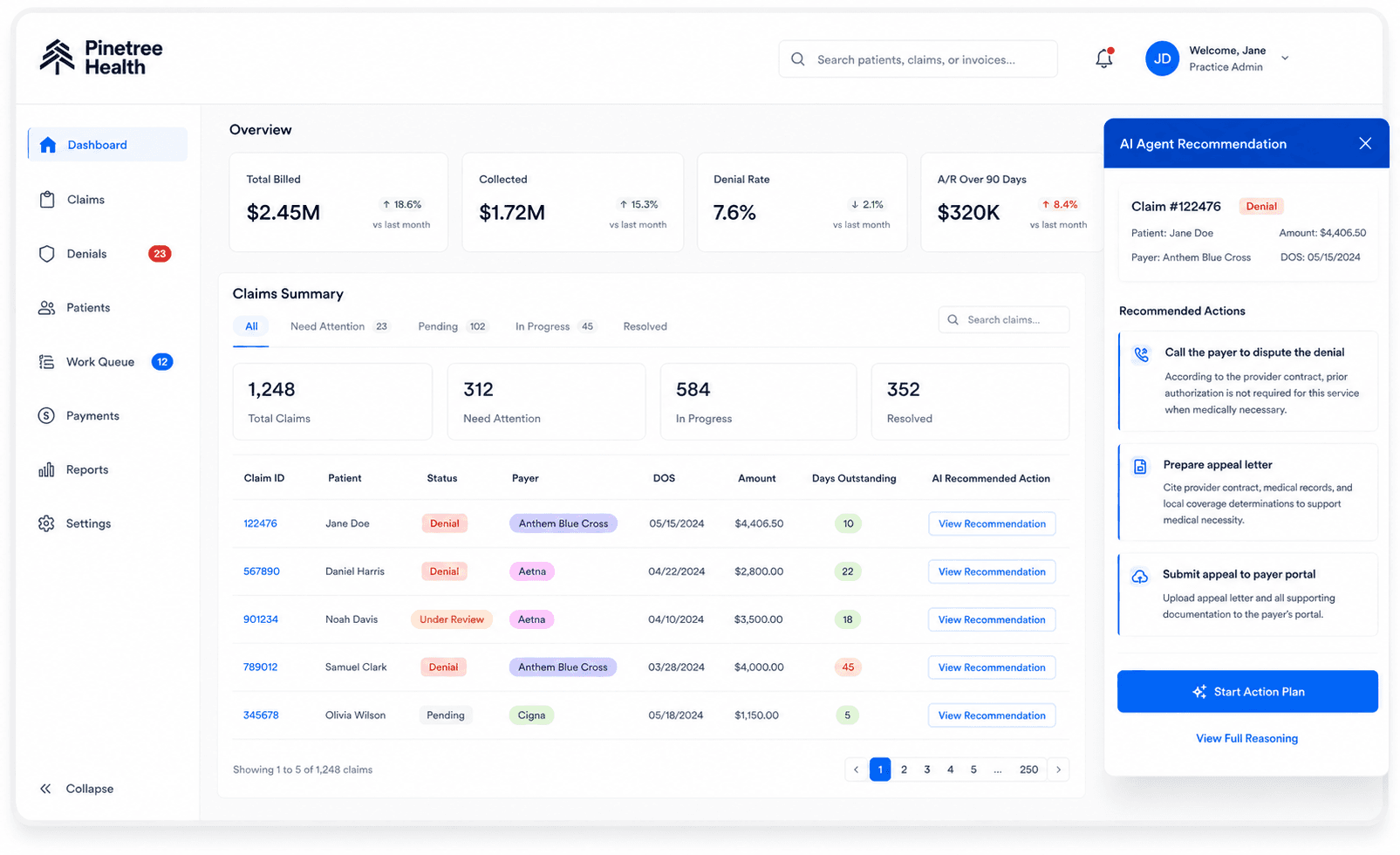
At Pinetree Health, we build AI tools specifically to automate these front-end checks, helping small practices submit clean claims the first time. By focusing on preventing denials before they happen, you can stabilize your cash flow and spend your time where it matters most: with your patients.