Is Outsourcing Medical Billing Worth It? A Guide for Small Practices

Is Outsourcing Medical Billing Worth It? A Guide for Small Practices
You didn't go to medical school to spend your evenings chasing down unpaid claims. Yet, for many small practice owners, that’s the reality. You’re juggling patient care with the constant, nagging pressure of managing your revenue cycle. One practice owner found their team was wasting more than twenty hours a week on billing duties. It’s no surprise that provider burnout is a massive issue, especially when claim errors are on the rise, with 55% of providers reporting an increase in errors in a recent survey.
If you’re wondering whether to outsource your medical billing, you’re asking the right question. You're not alone; projections show that 60% of small medical practices will outsource their billing by 2025.
But is it the right move for your practice? The answer isn't a simple yes or no. It depends on your current performance, your specialty, and your goals. This guide will walk you through a simple evaluation to help you decide.
How do I know if my current billing system is broken?
Before you can decide if you need help, you need a clear picture of how you're doing now. You don't need to be a billing expert to spot warning signs. Look at these three key performance indicators (KPIs) for your practice’s financial health.
1. What is your Clean Claim Rate?
This is the percentage of claims paid on the first submission without any errors. It's the single best measure of your billing accuracy. A low rate means your team is spending hours on rework, appeals, and follow ups.
What to aim for: Industry benchmarks show a healthy clean claim rate should be 95% or higher.
2. What is your Denial Rate?
This is the percentage of claims rejected by payers. While some denials are inevitable, a high rate points to serious issues in your process, from incorrect coding to problems with insurance verification.
What to aim for: Top performing practices achieve a denial rate under 5%.
3. How much of your revenue is stuck in aging A/R?
Accounts Receivable (A/R) is the money you are owed but have not yet collected. The longer it sits, the less likely you are to ever collect it. Pay close attention to claims older than 90 days.
What to aim for: Your A/R over 90 days should be less than 10-15% of your total receivables.
If your numbers are worse than these benchmarks, your billing process is likely costing you significant revenue and time.
What is my in-house billing really costing me?
Many practice owners only look at the salary of their in-house biller. But the true cost is much higher. When you do the math, remember to include all the direct and hidden expenses.
A complete in-house billing department requires you to budget for:
Salary and benefits: The base pay, payroll taxes, health insurance, and retirement contributions for your billing staff.
Software and fees: The monthly cost of your practice management software, electronic health record (EHR) system, and any clearinghouse fees. These can run from $140 to over $899 per provider per month.
Training and education: The cost of keeping your staff certified and up to date on the thousands of constantly changing CPT (Current Procedural Terminology) and ICD (International Classification of Diseases) codes.
The cost of errors: A single coding error can trigger denials and payment delays that cost your practice far more than the initial mistake.
Your time: What is the value of the hours you or your clinical staff spend on administrative tasks instead of patient care?
For many small practices, the biggest risk is relying on a single person. When your one biller goes on vacation, gets sick, or quits, your entire cash flow can grind to a halt.
What are my outsourcing options and what do they cost?
Outsourcing isn't a one size fits all solution. Today, small practices generally have three choices, each with a different level of cost and involvement.
1. The Traditional Billing Service (The "People" Model)
This is what most people think of when they hear "outsourcing." You hire an external company to manage your entire Revenue Cycle Management (RCM) process, from claim submission to denial management.
How it’s priced: Most use a percentage based model, typically charging between 3% and 9% of your monthly collections. Smaller practices and complex specialties like cardiology often pay a higher percentage, sometimes from 5% to 8%, because the vendor’s fixed costs are spread across fewer claims.
Pros: It can completely remove the administrative burden from your team.
Cons: It can feel like a "black box" with little transparency. You are also dependent on the quality of their human staff, which can be inconsistent.
2. RCM Software (The "Do It Yourself" Model)
This option involves buying powerful software to help your in-house team manage billing more efficiently. You are still responsible for the work, but the tool makes it easier.
How it’s priced: Usually a flat monthly fee per provider. For example, popular systems can range from around $199 to $729 per provider per month.
Pros: You maintain full control over your billing process and data.
Cons: You still need to hire, train, and manage an in-house expert to run the software, and you bear the full cost of their salary and benefits.
3. AI-Powered RCM Platforms (The "Hybrid" Model)
This is a newer, more modern approach. Instead of relying on a large team of people, these companies use artificial intelligence and automation to handle the most repetitive and error prone tasks, like scrubbing claims for errors before submission. This is often combined with a small team of experts who manage exceptions.
How it’s priced: Often a percentage based fee, but because automation reduces their labor costs, it can be more competitive. Some studies show AI-powered RCM can reduce operational costs by 30-40% compared to manual systems.
Pros: You get the benefit of outsourcing the work while gaining the accuracy and efficiency of technology. It’s often the best of both worlds for a small practice.
Cons: You need to be comfortable with a technology first approach and ensure the platform integrates smoothly with your existing EHR.
What questions should I ask before hiring a billing partner?
Once you start looking at vendors, it's easy to get overwhelmed. To find the right fit, you need to ask tough, specific questions that go beyond their sales pitch.
Performance: "What are your specific clean claim and first pass resolution rates for practices in my specialty?"
Integration: "How exactly will you integrate with my specific EHR system? Can you walk me through the technical process?"
Transparency: "What kind of reports will I get, and how often? Can I see a sample dashboard?"
The Transition: "What is your step by step plan for migrating my practice? Who is responsible for working old A/R, and how do you prevent cash flow gaps during the switch?"
Security: "Are you SOC 2 Type II and HIPAA compliant? How do you ensure my patient data is secure?"
Cost: "Is your fee based on total collections or just what you collect? Are there any setup fees, implementation fees, or long term contract requirements?"
Making a change can feel daunting, but sticking with a broken process is far riskier. Practices that make the switch often see dramatic results, with some reporting 40% fewer denials and getting paid 25% faster.
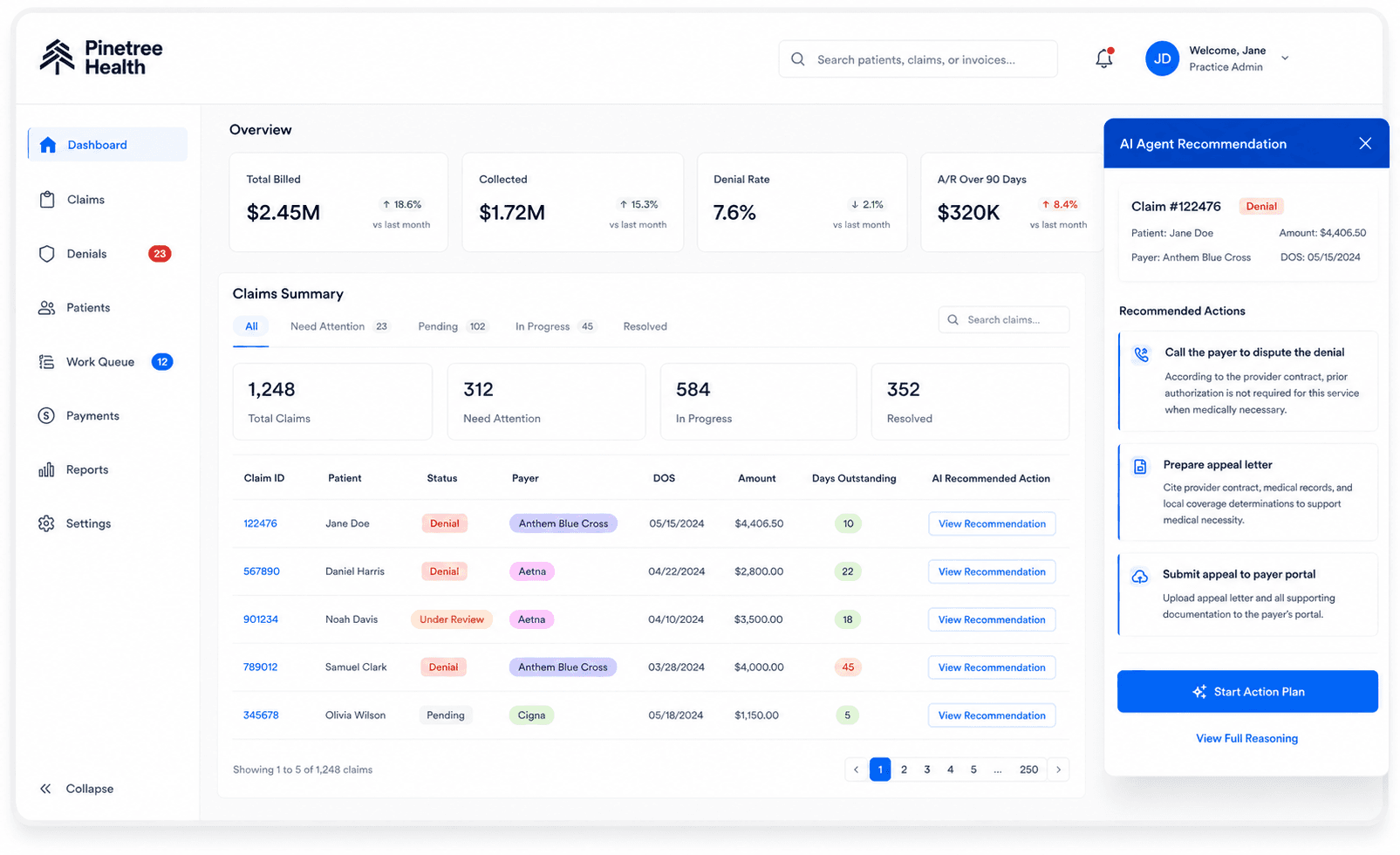
The goal is to find a partner that lets you focus on being a doctor again. For many small practices, modern solutions like Pinetree Health use AI to automate the administrative busywork, helping you get paid more, faster, and with far less hassle. By arming yourself with the right data and asking the right questions, you can make a confident decision that secures your practice’s financial future.