Is Your Small Practice Leaking Revenue? A 3-Step Audit to Find and Fix It

Is Your Small Practice Leaking Revenue? A 3-Step Audit to Find and Fix It
Your schedule is full. Your patients are getting excellent care. But when you look at your practice's finances, something doesn't add up. Cash flow is tight, and you have a nagging feeling that you’re working harder than ever for less and less money.
If this sounds familiar, you're not alone. Many small and solo specialty practices are dealing with revenue leakage: a slow, steady drain of earned income caused by small, often invisible, process gaps. These are not catastrophic billing errors. They are the thousands of dollars lost in small increments through things like incorrect coding, missed patient payments, and unpaid claims that silently age out.
The good news is you don’t need a massive billing department to plug these leaks. You just need to know where to look. Here is a simple 3-step audit you can perform to find and fix the most common sources of lost revenue in your practice.
Why does “paid” not always mean “paid correctly”?
One of the biggest misunderstandings in medical billing is the assumption that a paid claim is a correctly paid claim. Your Electronic Health Record (EHR) might show a zero balance, but that doesn't tell the whole story.
Payers are increasingly using automated claim processing to review and pay claims, and these systems often make mistakes. In fact, insurance companies underpay on their contracted rates in 5-10% of claims. This is a classic "silent leak." You provided a service and got paid, but you didn't get paid what you were owed. Over hundreds of claims, this adds up to a significant revenue gap.
These small, hidden losses are where a lean practice can find its biggest opportunities.
Where should I start looking for leaks? A 3-step audit
Instead of trying to boil the ocean, focus on the three areas where small practices lose the most money.
Step 1: Check your patient check-in process
The single best time to collect revenue is before the patient leaves your office. Your front desk is your first line of defense against revenue leakage, but they are often rushed and may feel uncomfortable talking about money.
Start by looking at your patient responsibility collections. The average patient now owes between $1,000 and $3,000 before their insurance pays anything. If you aren't collecting copays, deductibles, and balances at the time of service, you are creating a massive collections burden for yourself later. The data is clear: collecting payment before or during visits can double your collection rates.
What to do now:
Review your check-in workflow. Are you verifying insurance eligibility for every single patient, every single time? Are you providing clear cost estimates and collecting the patient's portion upfront? Simple technology can automate eligibility checks and help your staff have these financial conversations with confidence, turning a point of friction into a point of strength.
Step 2: Spot-check your most common codes
Fear of an audit causes many physicians to intentionally undercode their services. This is perhaps the most painful type of revenue leak because you did the complex work but chose not to bill for it.
The classic example is billing a level 4 evaluation and management (E/M) visit as a level 3. A physician might do this to avoid a potential review from the Centers for Medicare & Medicaid Services (CMS) or other payers, who monitor billing patterns for outliers. But that "safety" comes at a steep price. The reimbursement difference between a 99214 and a 99213 code is typically $40 to $60 per visit. If you see 10 of these patients a day, you could be leaving thousands of dollars on the table every month.
Other common coding leaks include:
Misunderstood add-on codes: Codes like G2211, which accounts for visit complexity, are often missed.
Incorrect modifiers: Forgetting to add modifier 25 when you perform an E/M service with a minor procedure on the same day will cause the insurer to bundle the payments, meaning you don't get paid for your E/M work.
What to do now:
Pull a report of your 10 most frequently billed CPT codes. Are you consistently defaulting to a lower-level code? If so, ask yourself if your documentation supports a higher level of service. Modern billing systems can use AI to review your documentation and flag potential undercoding, giving you the confidence to bill appropriately for the excellent care you provide.
Step 3: Audit your payer payments against your contracts
This is the sneakiest leak. As mentioned before, payers underpay their contracted rates on 5-10% of claims. These small discrepancies are almost impossible to catch manually, especially in a small practice where you don't have a full-time biller staring at every explanation of benefits.
A helpful metric to watch here is your Net Collection Rate. This tells you how much you are actually collecting from the amount you are allowed to be paid by payers. You can calculate it with a simple formula: (Payments Received / (Total Charges; Contractual Adjustments)) × 100. A healthy practice should see a rate well over 95%. If yours is lower, it could be a sign that you are not being paid according to your contracts.
What to do now:
You don’t have to review every single claim. Instead, pick your top five payers and spot-check 10-15 recently paid claims for each. Compare the payment amount to the fee schedule in your contract. If you find a pattern of underpayments, you have concrete data to take back to the payer. This is another area where technology is a game-changer. An AI-powered system can do this comparison automatically for every claim, flagging underpayments the moment they happen.
What is the one number I should track?
If you only have time to track one thing, make it your First Pass Resolution Rate (FPRR). This metric, also called a clean claim rate, measures the percentage of claims that are accepted and paid on the first submission.
A benchmark for a healthy practice is that at least 95% of your claims should get accepted on the first try.
Why is this number so important? Because every time a claim is denied, it costs you time and money. Your staff has to spend 15 to 30 minutes per denied claim just to research, correct, and resubmit it. And if you miss the payer’s deadline, which is often just 90 to 120 days, that revenue is lost forever. A low FPRR is a major warning sign that your Revenue Cycle Management (RCM) process has significant leaks.
You don't need more staff, you need a smarter system
Finding and fixing revenue leaks doesn't mean you have to work even harder or hire more people. It means shifting your focus from chasing down old denials to preventing them in the first place. By focusing on your front-desk process, coding accuracy, and payment verification, you can plug the most expensive leaks and build a more financially resilient practice.
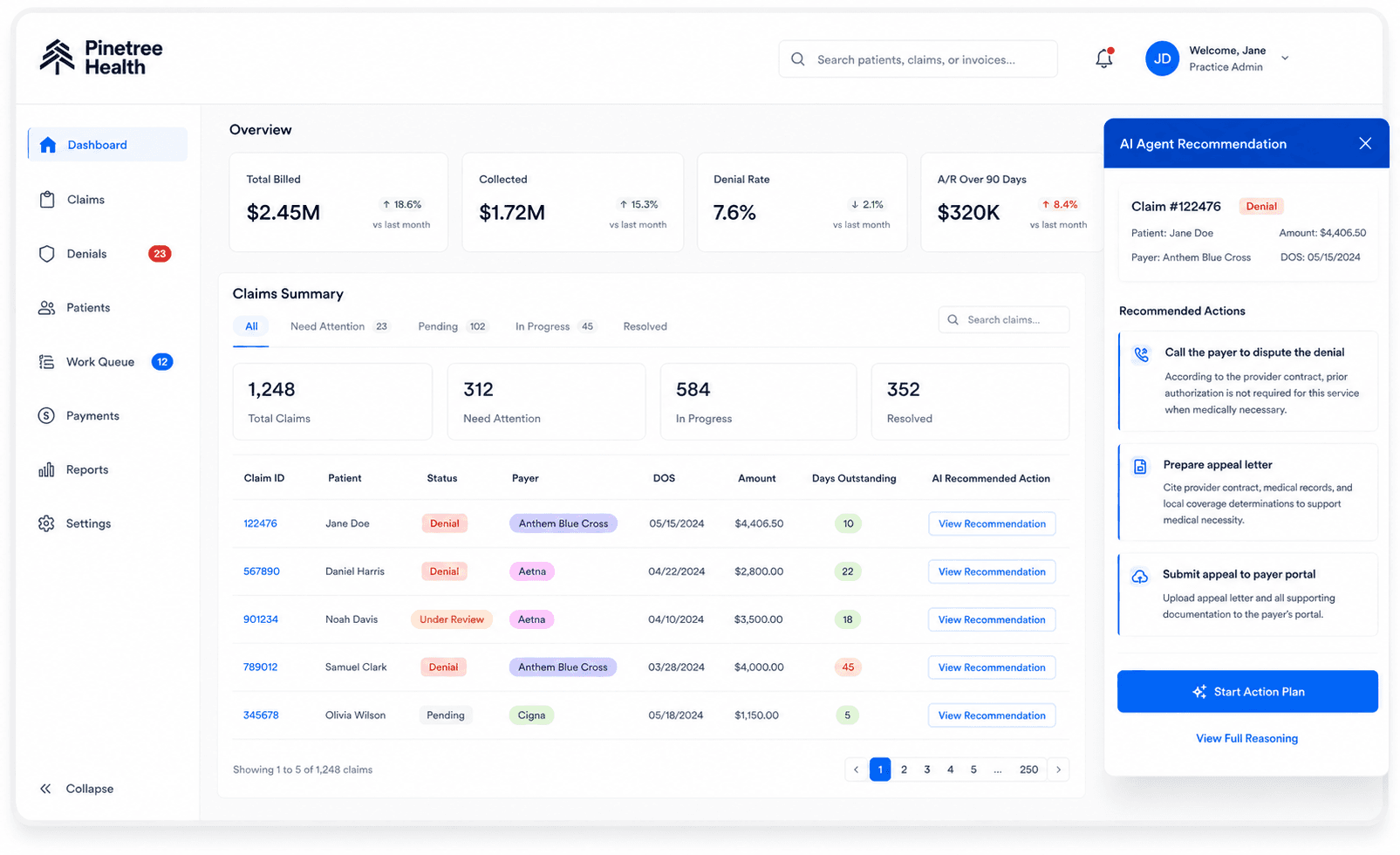
At Pinetree Health, we see how AI can automate this entire audit process, giving small practice owners the same powerful insights as a large hospital system. A smarter, more automated approach to your revenue cycle frees you up to focus on what actually matters: your patients.