Why Are My Medical Claims Denied? A Small Practice Survival Guide

Why Are My Medical Claims Denied? A Small Practice Survival Guide
You did the work. You saw the patient, provided excellent care, and submitted the claim. Then, weeks later, you get the notification: Denied. It’s a frustratingly common story for small and solo practices. The paperwork piles up, cash flow slows to a trickle, and you spend more time on hold with payers than you do with patients.
If it feels like claim denials are getting more frequent and more confusing, you’re not wrong. The system is getting more complex, and small practices are feeling the squeeze. But most denials don't happen for complex clinical reasons. They come from simple, preventable mistakes that can be fixed before a claim ever goes out the door.
This guide will walk you through why this is happening and give you a prioritized, practical plan to stop denials before they start.
Why does it feel like more claims are being denied?
The short answer is that payers are getting more aggressive. Many have shortened their filing deadlines and removed the grace periods practices used to rely on. At the same time, insurers are using their own technology to find reasons to deny payment. In fact, 61% of physicians say AI-driven prior authorizations have increased denials, automatically flagging valid services.
Add to this the increasing complexity of medical coding. The World Health Organization's ICD-11 (International Classification of Diseases, 11th Revision) update, for example, includes over 17,000 unique diagnostic categories and 130,000 clinical terms. For a small practice without a dedicated coder, keeping up is a monumental task.
It’s a perfect storm that leaves practice owners and their small teams feeling burned out and buried in administrative work. But you don't have to accept it.
First, is it a rejection or a denial?
Before you can fix the problem, it helps to know exactly what you’re dealing with. The terms are often used interchangeably, but they mean very different things for your workflow.
A rejection happens before the claim is even processed. Your clearinghouse or the payer’s system kicks it back because of a basic formatting error, like a typo in a patient’s name or an invalid ID number. Think of it as a letter with the wrong zip code; it’s returned to sender without ever being opened. These are usually fast fixes you can make and resubmit immediately.
A denial means the payer processed your claim and has decided not to pay it for a specific reason. This is a formal decision that often requires a more involved correction or a formal appeal.
According to one analysis, many denials can be resolved with a corrected resubmission rather than a formal appeal. But the best strategy is to avoid both rejections and denials by submitting a “clean claim” from the start; one that gets paid on the first pass without any issues.
Where should I focus my effort to stop denials?
When you’re short on time, you can’t fix everything at once. The good news is that most of your denials likely stem from just a few root causes. Let’s focus on the three biggest leaks in your practice’s revenue bucket.
1. Fix the front door: Patient intake and registration
It sounds basic, but it’s the single biggest source of problems. Missing or inaccurate data is responsible for 50% of denials, with another 26% of denials attributed to incomplete registration and intake data.
A simple transposed digit in an insurance ID, an outdated address, or a misspelled name is all it takes for a claim to be rejected. In a busy practice, it's easy for your front desk person (who might also be your office manager and part-time biller) to miss these details.
Your Action Plan:
Create a simple, non-negotiable check-in process. At every single visit, for every single patient, ask them to review their information and present their current insurance card. Don’t just ask, “Has anything changed?” People often forget about a new insurance plan until they are prompted. Verifying this information upfront prevents a huge number of downstream issues.
2. Master the maze: Prior authorizations
Prior authorizations are the bane of nearly every medical practice. They are a constant source of friction, delaying care and creating enormous administrative headaches. They are also a massive source of denials.
An analysis found that missing prior authorizations contribute to 21% of denials, and they are especially common for specialty care and high-cost services. The responsibility for obtaining one falls on both the patient and the provider, but ultimately, the provider's office is on the hook for making sure it’s in place before a service is rendered.
Your Action Plan:
Create a list of the common procedures and services in your practice that require prior authorization. For each major payer you work with, document their specific authorization process. While this takes time upfront, having a clear checklist for your staff can prevent thousands of dollars in denials for services you’ve already performed.
3. Sweat the small stuff: Documentation and coding
After front-end errors, the next biggest category of denials comes from clinical and coding issues. This can be anything from using a CPT (Current Procedural Terminology) code that doesn’t match the patient’s diagnosis to not providing enough documentation to prove a service was medically necessary.
These types of errors are costly, with 35% of total denials attributed to documentation mistakes. While you are the clinical expert, translating that expertise into the specific language payers require is a separate skill.
Your Action Plan:
When you get a denial, don’t just write it off. Look at the denial code. Is it the same code over and over? Is it for the same procedure? Tracking these patterns will show you where your process is breaking down. Maybe a specific CPT code needs an extra modifier, or maybe a certain diagnosis requires more detailed notes. Identifying the pattern is the first step to fixing the root cause.
Is it even worth it to appeal denied claims?
Yes and no. On one hand, appealing can be surprisingly effective. For instance, a government report found that Medicare Advantage organizations overturned 75% of their own denials upon appeal between 2014 and 2016. This shows that payers often deny valid claims, and pushing back works.
But for a small practice, the math is different. Do you have the staff hours to fight a denial for a $75 claim? Probably not. This is why a prevention-first mindset is so critical. Every denial you prevent saves you the time, energy, and lost revenue of chasing down a payment you already earned.
By focusing on your front-end processes; verifying patient data, confirming authorizations, and ensuring documentation is clean; you can plug the biggest leaks and keep your revenue cycle healthy. That's the foundation of a financially strong practice.
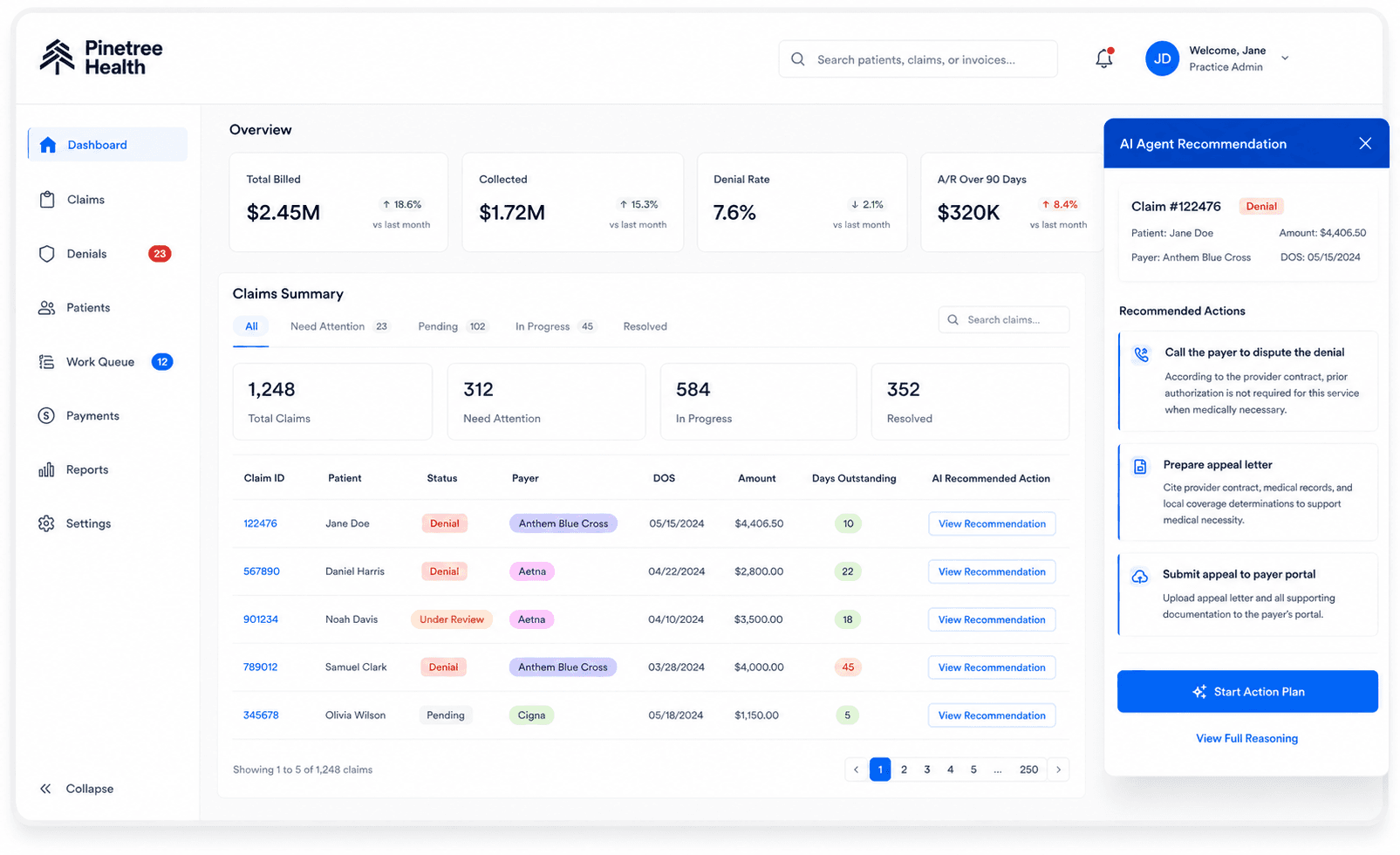
At Pinetree Health, we see how administrative burden crushes small practices. It’s why we help providers use smart automation to catch errors at the source, freeing up their teams to focus on patients, not paperwork.